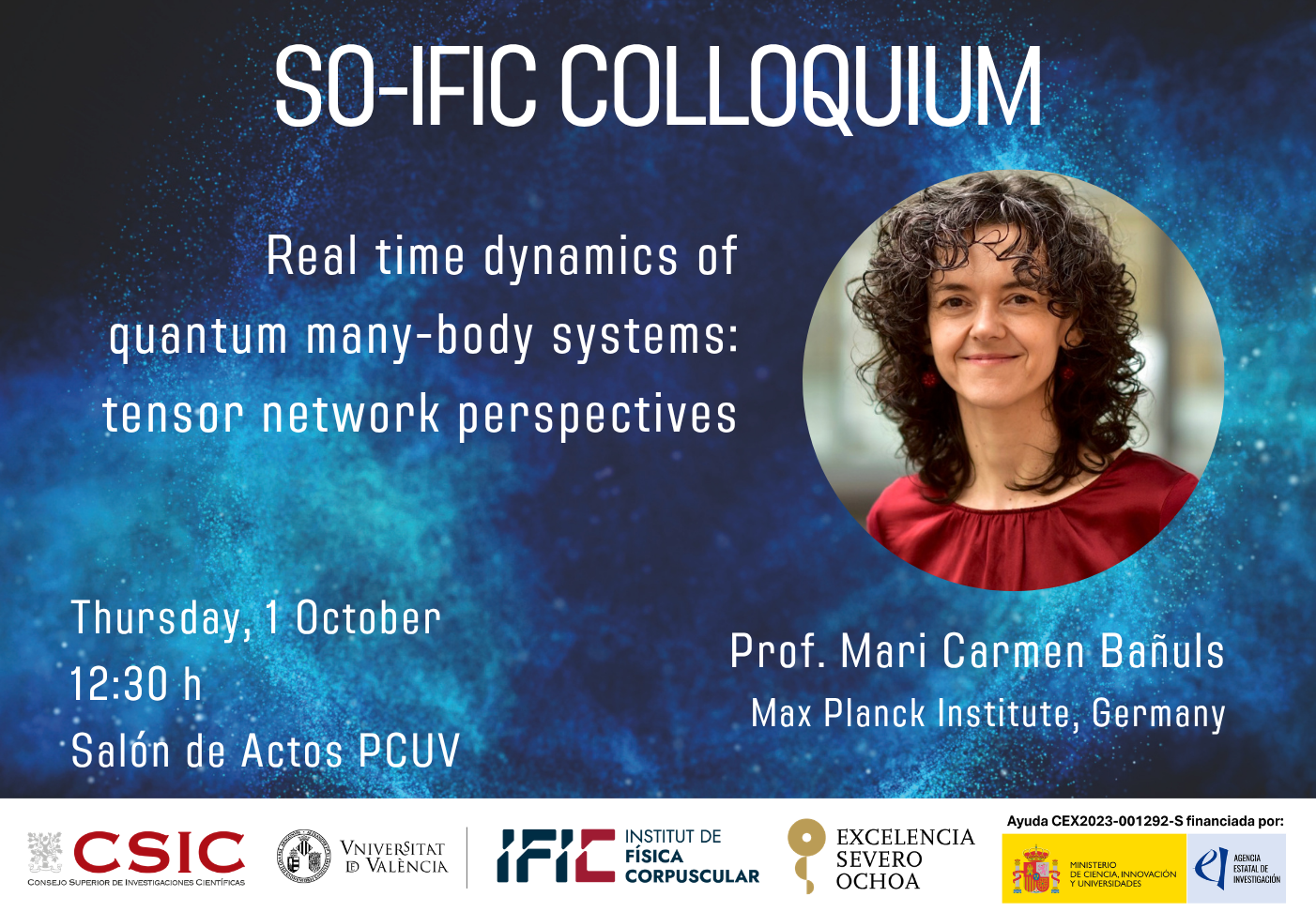
Real time dynamics of quantum many-body systems: tensor network perspectives
por
Salón de Actos
PCUV
Abstract:
Understanding how interacting quantum particles evolve in time is one of the major challenges in quantum physics, and it affects questions ranging from the study of thermalization to quantum information processing.
Tensor networks are a family of quantum-information-based techniques to efficiently represent quantum many body states, and provide one of the most promising methods to study non-equilibrium setups. However, the growth of entanglement during quantum evolution severely limits the application of standard algorithms to this problem.
In this talk I will introduce a recent approach, the so-called “transverse folding”, which tries to avoid this difficulty by focusing on local properties, and representing them as a space-time tensor network. This space-time dual picture gives rise to a new perspective on how information evolves in quantum dynamics. In particular, one can define “temporal vectors” and temporal entropies, which are crucial to determine the efficiency of the strategy, and reveal a rich structure of correlations.
Link to the recorded colloquium
IFIC Colloquia organizers