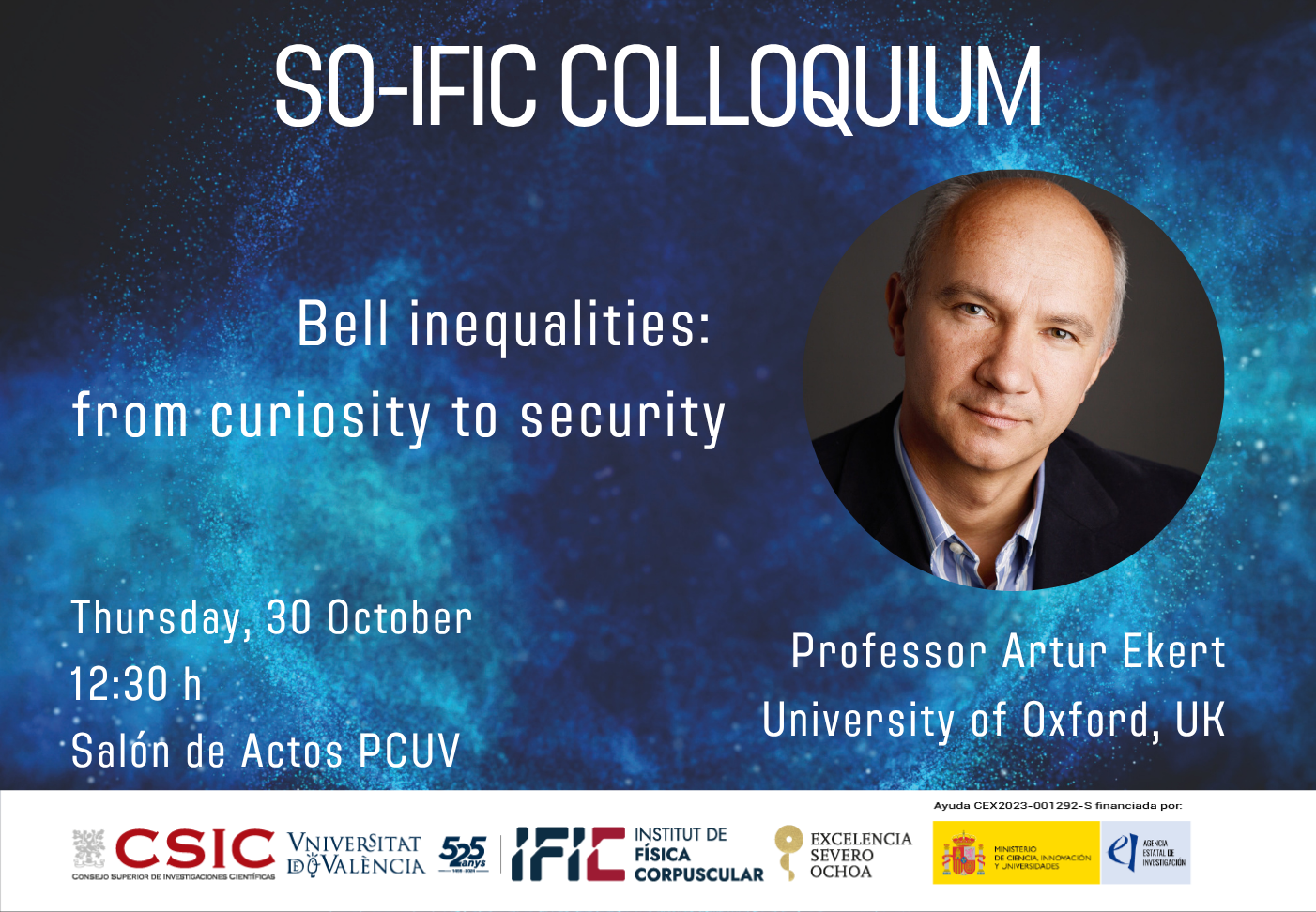
Bell inequalities: from curiosity to security
por
Salón de Actos
PCUV
Proposed by John Bell in 1964 to test the completeness of quantum theory, Bell inequalities were long regarded as philosophical curiosities. Early experimental violations drew little attention, as most physicists focused on the predictive success of quantum mechanics rather than its interpretation. In 1991, Bell inequalities were reframed as a tool for detecting eavesdropping in cryptography, leading to the concept of device-independent quantum key distribution—secure communication certified by quantum nonlocality itself. This new perspective revitalised quantum foundations and spurred experimental efforts to close all loopholes in Bell tests. What began as almost a philosophical pursuit has become the cornerstone of the most advanced cryptographic systems proposed to date.
Link to the colloquium
IFIC colloquium organizers